An Appreciation, Brief Edition, Eighth Edition, By Roger Kamien Download Free Pdf
| Qualities | |
|---|---|
| Number of pitch classes | half-dozen |
| |
| Forte number | vi-35 |
| Complement | half-dozen-35 |

The two whole-tone scales as a symmetrical partitioning of the chromatic scale;[one] if C=0 then the top stave has fifty-fifty (02468t) and the bottom has odd (13579e) pitches
In music, a whole-tone calibration is a scale in which each note is separated from its neighbors by the interval of a whole tone. In twelve-tone equal temperament, there are just 2 complementary whole-tone scales, both six-note or hexatonic scales. A single whole-tone scale tin can besides exist thought of as a "six-tone equal temperament".

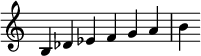
The whole-tone calibration has no leading tone and because all tones are the same distance apart, "no single tone stands out, [and] the scale creates a blurred, indistinct effect".[2] This result is especially emphasised by the fact that triads built on such scale tones are all augmented triads. Indeed, all six tones of a whole-tone scale tin be played merely with ii augmented triads whose roots are a major second apart. Since they are symmetrical, whole-tone scales practice not requite a strong impression of the tonic or tonality.
Only ii triads are possible, both of them augmented, and...all inversions audio alike. All 'progressions' tend to have the aforementioned tonal graphic symbol. What one hears are tone centers rather than tonics, and merely when they are stressed [emphasized], as by repetition or duration. It cannot be denied that the small number of possible different intervals [only even semitone intervals: 2, 4, vi, 8, 10] and nonequivalent chords bachelor in the whole-tone scale results in a soft-edged, neutral kind of sound lacking in tonal contrast.... Since the 1930s...whole-tone harmony...has become one of the platitudes of the "Hollywood Style."
The composer Olivier Messiaen chosen the whole-tone scale his first mode of limited transposition. The composer and music theorist George Perle calls the whole-tone calibration interval wheel 2, or C2. Since in that location are only two possible whole-tone-scale positions (that is, the whole-tone calibration tin can exist transposed only once), it is either C20 or C2ane. For this reason, the whole-tone scale is also maximally fifty-fifty and may be considered a generated collection.
Due to this symmetry, the hexachord consisting of the whole-tone scale is not distinct under inversion or more than one transposition. Thus many composers have used one of the "near whole-tone" hexachords, whose "private structural differences tin be seen to issue simply from a difference in the 'location', or placement, of a semitone inside the otherwise whole-tone series."[4] Alexander Scriabin's mystic chord is a primary example, being a whole-tone scale with 1 annotation raised a semitone; this alteration allows for a greater variety of resources through transposition.[5]
Classical music [edit]
In 1662, Johann Rudolf Ahle wrote a melody to the lyrics of Franz Joachim Burmeister's "Es ist genug" (Information technology is enough), beginning information technology with four notes of the whole-tone scale on the four syllables.[ clarification needed ] Johann Sebastian Bach chose the chorale to terminate his cantata O Ewigkeit, du Donnerwort, BWV 60, fix for 4 parts. The first iv measures are shown below.
![\new PianoStaff << \new Staff << \new Voice \relative c' { \stemUp \clef treble \key f \major \time 4/4 \[ f2 g4 a b2 \] r4 b c4 g g bes! a2. } \new Voice \relative c' { \stemDown c2 c4 bes8 a e'2 s4 e e4. f8 e d e c f2. } >> \new Staff << \new Voice \relative c' { \stemUp \clef bass \key f \major \time 4/4 a2 g4 d' d2 r4 gis, a8 b c4 c c c2. } \new Voice \relative c { \stemDown f2 e4 fis gis2 s4 e a8 g!16 f e8 d c bes! a g! f2. } >> >>](https://upload.wikimedia.org/score/viii/3/833ctj78p61r0nisuerg7hiw19l273v/833ctj78.png)
Mozart also used the scale in his Musical Joke, for strings and horns.[6]

Whole-tone scales created past sequent secondary diminished seventh chords in Chopin's Op. 28, No. nineteen: Prelude (1832)[7] The notes of ane whole-tone scale are colored red (East ♭ ) and the notes of the other are blue (Eastward); chromaticism is accompanied by whole-tone scale melodic progression, every bit in the bass.
In the 19th century, Russian composers went further with melodic and harmonic possibilities of the scale, often to depict the ominous; examples include the endings of the overtures to Glinka's opera Ruslan and Lyudmila and Borodin'due south Prince Igor, and the Commander'south theme in Dargomyzhsky's The Rock Guest. Farther examples can be found in the works of Rimsky-Korsakov: the sea rex's music in Sadko and also in Scheherazade. Shown beneath is the opening theme to Scheherazade, which is "simply a descending whole-tone scale with diatonic trimmings."[eight] Notes in the whole-tone scale are highlighted.
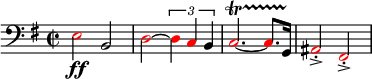
(For some brusk pianoforte pieces written completely in whole-tone scale, run across Nos. 1, 6, and 7 from V.A. Rebikov's Празднество (Une fête), Op. 38, from 1907.)
H. C. Colles names as the "childhood of the whole-tone scale" the music of Berlioz and Schubert in France and Austria then Russians Glinka and Dargomyzhsky.[nine] Claude Debussy, who had been influenced by Russians, forth with other impressionist composes made extensive use of whole-tone scales. Voiles, the second piece in Debussy's get-go book of Préludes, is almost entirely within one whole-tone scale.[10] [11] The opening measures are shown beneath.

Janáček's employ of the calibration in the bracing opening to the second movement of his Sinfonietta is, to quote William West. Austin, "utterly different". Austin writes, "Janáček'south gratis chromaticism never loses touch with a diatonic scale for long. Though the whole-tone calibration is prominent in much of his music afterward 1905 when he encountered Debussy, it serves just to fit the motifs over augmented chords. The same motifs return from the whole-tone to the diatonic calibration without emphasizing the dissimilarity."[12] The start measures of the second movement of Sinfonietta are shown below.

Giacomo Puccini used whole-tone scales as well as pentatonic scales in his 1904 opera Madama Butterfly to imitate east Asian music styles.
The first of Alban Berg's Seven Early on Songs opens with a whole-tone passage both in the orchestral accompaniment and in the vocal line that enters a bar later.[13] Berg also quotes the Bach chorale setting referred to higher up in his Violin Concerto. The last four notes of the 12-tone row Berg used are B, C ♯ , East ♭ and F, which, together with the starting time note, G, comprise five of the six notes of the calibration.)
Béla Bartók too uses whole-tone scales in his 5th string quartet.[14] Ferruccio Busoni used the whole-tone calibration in the right hand role of the "Preludietto, Fughetta ed Esercizio" of his An die Jugend, and Franz Liszt had used the technique as early every bit 1831, in the Grande Fantaisie sur La clochette.[xv]
Jazz [edit]
Some early instances of the utilize of the calibration in jazz writing can be found in Bix Beiderbecke's "In a Mist" (1928) and Don Redman's "Chant of the Weed" (1931). In 1958, Gil Evans recorded an organisation that gives striking coloration to the "abrupt whole-tone lines"[xvi] of Redman'southward original. Wayne Shorter's limerick "JuJu" (1965),[17] features heavy utilise of the whole-tone scale, and John Coltrane'due south "Ane Down, One Up" (1965), is built on 2 augmented chords bundled in the same simple structure every bit his earlier tune "Impressions".[18]
Yet, these are merely the most overt examples of the use of this scale in jazz. A vast number of jazz tunes, including many standards, use augmented chords and their corresponding scales equally well, usually to create tension in turnarounds or as a substitute for a ascendant seventh chord. For instance a G7 augmented 5th dominant chord in which Thousand altered scale tones would work before resolving to C7, a tritone substitution chord such as D ♭ nine or D ♭ 7 ♯ 11 is oft used in which D ♭ /Chiliad whole-tone scale tones volition work, the sharpened 11th caste being a G and the flattened 7th beingness a C ♭ , the enharmonic equivalent of B, the major third in the G ascendant chord.
Art Tatum and Thelonious Monk are two pianists who used the whole-tone scale extensively and creatively. Monk's "Four in One" (1948)[19] and "Trinkle-Tinkle" (1952)[20] are fine examples of this.
A prominent example of the whole-tone scale that made its way into pop music are confined ii and iv of the opening of Stevie Wonder'southward 1972 song "You Are the Sunshine of My Life".[21]
Non-Western music [edit]
The raga Sahera in Hindustani classical music uses the same intervals as the whole-tone scale. Ustad Mehdi Hassan has performed this rāga.[ citation needed ] Gopriya is the corresponding Carnatic rāgam.
See also [edit]
- Altered scale
References [edit]
- ^ Piston, Walter (1987/1941). Harmony, p. 490. 5th edition revised by Devoto, Marking. Due west. Westward. Norton, New York/London. ISBN 0-393-95480-iii.
- ^ Kamien, Roger (2008). Music: An Appreciation, Sixth Cursory Edition, p.308. ISBN 978-0-07-340134-eight.
- ^ Piston (1987/1941), p. 492.
- ^ Schmalfeldt, Janet (1983). Berg'due south Wozzeck: Harmonic Language and Dramatic Design, p.48. ISBN 0-300-02710-9.
- ^ "The Development of Twelve-Annotation Music", p. 56. Oliver Neighbor. Proceedings of the Royal Musical Association, 81st session (1954–1955), pp. 49–61.
- ^ Rosen, Charles (January 1995). The Romantic Generation. Cambridge, Mass. pp. 556. ISBN0674779339. OCLC 31710528.
- ^ Piston (1987/1941), p. 491. Piston analyses vii o 7 every bit V o
nine (with a missing/implied root) and doesn't include macro analysis. - ^ Abraham, Gerald. "The Whole-Tone Scale in Russian Music", p. 602, The Musical Times, vol. 74, no. 1085. (July 1933), pp. 602–604.
- ^ "The Childhood of the Whole-Tone Scale", pp. 17-nineteen. H. C. Colles. The Musical Times, vol. 55, no. 851. (January 1, 1914), pp. 16–20.
- ^ Benward & Saker (2009). Music in Theory and Practise: Volume Two, p. 246. Eighth edition. ISBN 978-0-07-310188-0.
- ^ Benward & Saker (2003). Music: In Theory and Practise, Vol. I, p. 39. 7th edition. ISBN 978-0-07-294262-0.
- ^ Austin, William West. (1966). Music in the 20th Century: From Debussy through Stravinsky. New York: W. W. Norton. p. 81. ISBN0393097048. OCLC 504195.
- ^ Berg (1928), Sieben Fruhe Lieder, Wien, Universal Edition
- ^ Cooper, David (1996). Bartók: Concerto for Orchestra . Cambridge: Cambridge University Press. p. 70. ISBN0521480043. OCLC 32626039.
- ^ Jeremy Nicholas, "Loving Liszt", Limelight, April 2011, p. l
- ^ Harrison, Max (1960) "Gil Evans: the Arranger as re-composer", article in Jazz Monthly, February.
- ^ Wayne Shorter Jazz Play Along, Milwaukee,Hal Leonard
- ^ Impressions (sheet music, 1991) from The Music of John Coltrane, Milwaukee, Hal Leonard
- ^ Four in One from Cardenas, S. and Sickler, D. (eds.) Thelonious Monk Fakebook, Milwaukee, Hal Leonard.
- ^ "Trinkle-Tinkle" from Cardenas, S. and Sickler, D. (eds.) Thelonious Monk Fakebook, Milwaukee, Hal Leonard.
- ^ Everett, Walter (2008). The Foundations of Rock : From "Blueish Suede Shoes" to "Suite: Judy Bluish Eyes". Oxford Academy Printing. p. 174. ISBN9780199718702.
External links [edit]
- The whole tone calibration for piano
- Whole Tone Scale – Analysis
- The Whole Tone Scale and Applications for Jazz Guitar
DOWNLOAD HERE
Posted by: stevensoncratintly72.blogspot.com


0 Komentar
Post a Comment